Listen to an audio version of this page.
 Listen to an audio version of this page.
 |
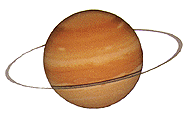
Jupiter: The Largest Planet |
| Jupiter is so large that all of the other planets in the solar system could fit inside of it. |
|
Jupiter is a large gas planet whose clouds change colors daily. This planet is made mostly of hydrogen and helium gases. Jupiter gives off two times more heat than it gets from the Sun. It shines very brightly in the night sky for nine months of the year when it is closest to Earth. Huge areas of swirling gases can be found in Jupiter's atmosphere. The largest swirling area of gas is called the Great Red Spot. Scientists believe this is a large hurricane-like storm which has lasted for hundreds of years. Large bolts of lightning have also been seen in Jupiter's atmosphere. Pictures taken by space probes have shown thin rings around Jupiter. As of January 2011, Jupiter has 50 named moons. 13 more have been discovered but not given official status or names. One of Jupiter's moons, Io, has active volcanoes on it. Areas on Io that are near the volcanoes are very, very hot. |
|
 |
A Question What is the Great Red Spot? |
 |
 |
 |
 |
| Show me the Level 2 version of this page. |

|
Return to the StarChild Main Page |
Go to Imagine the Universe! (A site for ages 14 and up.) |

|
The StarChild site is a service of the High Energy Astrophysics Science Archive Research Center (HEASARC), within the Astrophysics Science Division (ASD) at NASA/ GSFC.
StarChild Authors: The StarChild Team
StarChild Graphics & Music: Acknowledgments
StarChild Project Leader: Dr. Laura A.
Whitlock
Curator:
Responsible NASA Official: