 |
Pluto: A Dwarf Planet |
|
Pluto: A Dwarf Planet |

 |
Guess what?After its discovery in 1930, Pluto was classified as the ninth solar system planet. Pluto was re-classified as a dwarf planet in August 2006. |
|
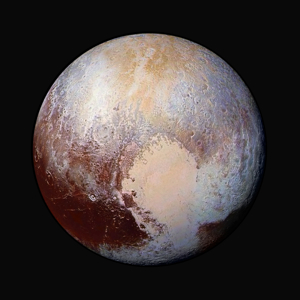
Until the fly-by of NASA's New Horizons spacecraft in 2015, little was known about Pluto. It was believed to be composed of rock and ice. It was also believed that it had a very thin atmosphere composed of nitrogen and methane, which would expand or freeze to the surface depending on how far Pluto was from the Sun. It was known that it had one large moon named Charon, which was about half of Pluto's size, and that Pluto was tilted 122.5 degrees on its axis, which basically meant that it was rotating on its head. It was known that Pluto had an extreme, elliptical orbit. Because of the shape of Pluto's orbit, it actually slips inside of Neptune's orbit once every 248 Earth years for a period of twenty years. Pluto was thought to be heavily cratered from billions of years of impacts. Observations made by New Horizons showed that Pluto was a much more interesting place than scientists had ever imagined. It has a tannish-red surface, probably from the presence of tholins. Tholins are created by the interaction of ultraviolet light from the Sun with methane. Tholins will form a red debris on the surface, possibly giving Pluto its color. Contrary to what scientists had believed, only a few craters were seen on the surface. This proves that the surface of Pluto is somehow still being shaped. Scientists are currently unsure how a cold place could have enough geologic activity to change the surface, but the evidence for it is abundant. Resolving this mystery is currently the focus of many astronomers around the world. The side of Pluto facing Charon looks different than the opposite side. On the side facing Charon, there is a series of four dark areas located near the equator. Each area is about the size of the State of Missouri (200-300 kilometers across). On the opposite side, there is a very bright area that is shaped like a heart and one large elongated dark area along the equator. Close up images of Pluto's surface shows tall water ice mountains, covered with layers of frozen methane and nitrogen. The average surface temperature for Pluto is around 40 Kelvin. At such low temperatures, water ice behaves like rock and can rise up to great heights without collapsing. Observations during the New Horizons fly-by have allowed scientists to theorize what the inside of Pluto must be like. It is believed that Pluto has a small rocky core surrounded by a thick mantle of ice. Scientists arrived at these conclusions by looking at materials common in the outer solar system and how such materials react to temperature and pressure. In addition, Pluto's interaction with Charon allowed for a determination of Pluto's mass, and therefore its density. We now know there are at least five moons of Pluto. Charon, Nix, Hydra, Kerberos, and Styx have all been confirmed by both ground and fly-by observations. However, there are still many things we do not know or understand about Pluto. Data from the New Horizons mission will be analyzed for many years to come in an effort to unravel the mysteries uncovered at Pluto. |
|
A QuestionWhat is so unusual about Pluto's moon Charon? |
 |
 The Facts |
 Did you know? |
 The Answer |

| Show me the Level 1 version of this page. |

|
Return to the StarChild Main Page |
Go to Imagine the Universe! (A site for ages 14 and up.) |
 |
The StarChild site is a service of the High Energy Astrophysics Science Archive Research Center (HEASARC), within the Astrophysics Science Division (ASD) at NASA/ GSFC.
StarChild Authors: The StarChild Team
StarChild Graphics & Music: Acknowledgments
StarChild Project Leader: Dr. Laura A.
Whitlock
Curator:
Responsible NASA Official: